Daily life in Aden during the Rasulid period
A grounded look at a Red Sea and Indian Ocean port where water storage, customs work, shipping, household crafts, and crowded markets shaped ordinary routines.
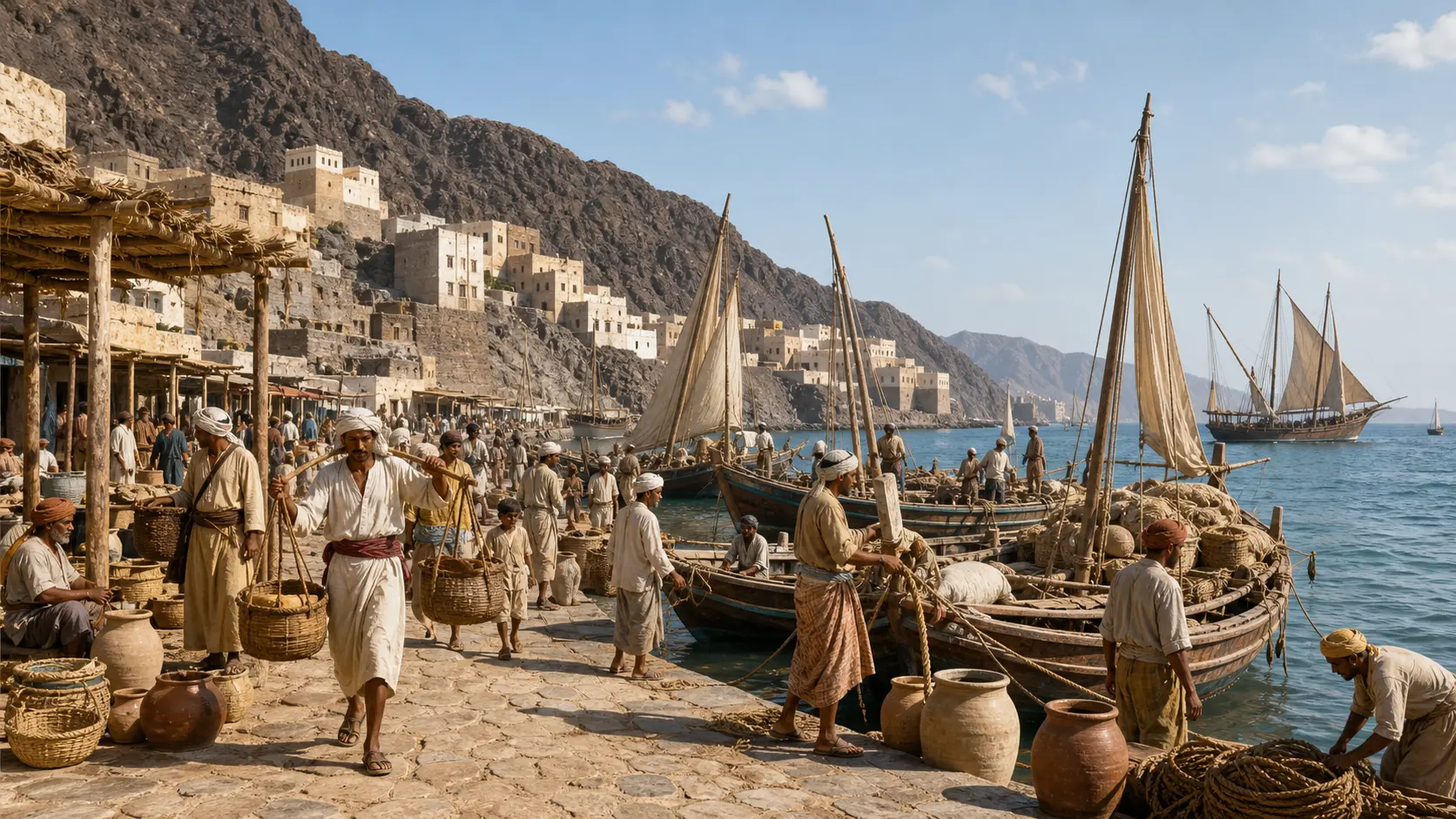
From 1229 to 1454 the Rasulid sultans ruled much of southern and western Yemen, usually from inland capitals, while Aden supplied a large share of their commercial revenue. The harbor linked the Red Sea and Egypt with the Hijaz, the Horn of Africa, western India, and routes farther east. Because the volcanic peninsula offered little cultivable land, the city depended on provisions and fuel brought by sea or overland from places such as Lahij and the Yemeni highlands. Shipping seasons, customs control, water supply, and the arrival of food therefore affected life well beyond the quay.[1][2]
The evidence is much better for government and trade than for a representative Aden household. The late 13th-century Nūr al-maʿārif preserves working lists and instructions on taxes, prices, crafts, court supplies, shipping seasons, and Aden's customs house; a 15th-century fiscal treatise adds administrative procedure.[2][3] Chronicles and travelers describe exceptional events and prominent people. Documents from the Cairo Geniza illuminate Aden especially before Rasulid rule and chiefly through a network of Jewish merchants.[4] These records establish systems of supply and labor, but seldom identify who cooked, carried water, or shared a room in an ordinary free household.
Housing and Living Spaces
Housing in Rasulid Aden was constrained by the fortified town's position among the rocky slopes of the Shamsan massif and by its separation from the harbor and customs enclosure. Stone, plaster, and imported or reused timber were available building materials, but neither the fiscal registers nor the limited archaeology supplies a standard Rasulid house plan. Earlier descriptions and Geniza documents locate warehouses, markets, harbor facilities, and water sources; they cannot safely prove that later rich and poor homes followed a single arrangement.[4] Merchants and officials needed secure space for people, papers, and goods, whereas sailors, servants, artisans, and poorer residents may have rented or shared more restricted accommodation. Exact room uses, furniture, and rules of privacy remain largely unrecoverable.
Domestic tasks must often have overlapped with storage and small-scale work, especially where a shop or workshop adjoined living space, but this is reconstruction rather than an inventory of a documented home. Jars, lamps, mats, baskets, locks, and grinding equipment are plausible necessities in the material setting; their distribution by income, gender, or neighborhood is not recorded well enough to describe an “ordinary” set of possessions. Heat, salt air, insects, dust, and crowding would have made shade, ventilation, cleaning, and repair recurrent concerns, while wealth bought more space, labor, and replaceable goods.
Water was a harder limit. Medieval writers attest wells and rain-catching cisterns at Aden, and the city's channels and tanks also diverted dangerous runoff from the mountain. Their construction occurred in several periods, however, and the surviving Tawila cisterns were cleared and repaired in the 19th century; their present appearance should not be treated as an intact Rasulid installation.[4][9] How consistently particular tanks functioned during the Rasulid centuries is uncertain. Whatever the mix of wells, cistern water, and supplies from outside the peninsula, water had to be fetched and stored. Cost and access would have shaped drinking, cooking, washing, and ritual ablution differently for wealthy households, dependent workers, and travelers.
Food and Daily Meals
Aden's food supply depended on movement. Fiscal records name Yemeni wheat, sorghum, dates, grapes, livestock, fish, and many traded foodstuffs, but a customs list records availability and taxation rather than the contents of everyone's bowl.[3] One unusually concrete example is a ship from Kilwa that reached Aden in 1336 carrying rice; ships from Mogadishu and other Swahili ports also arrived regularly with foodstuffs among their cargoes.[5] Overland traffic from agricultural districts mattered at least as much. A failed caravan, delayed ship, damaged store, or change in duty could therefore affect both price and choice.
Meals varied by means, season, origin, and religious calendar. Bread or porridge made from wheat or sorghum, pulses, dates, dairy products, fish, and occasional meat are consistent with Yemen's documented production and Aden's trade, while rice and imported spices were available through the port. The evidence does not support the page's former precise division between a standard merchant menu and a standard working household menu. Nor does it show coffee as a dominant everyday drink in Rasulid Aden. Court provision lists and elite hospitality reveal what rulers could assemble, not what porters, enslaved people, visiting crews, or poorer families usually ate.
Food preparation still required recurrent labor: buying and cleaning grain, grinding or arranging milling, carrying water and fuel, tending a hearth or oven, and protecting supplies from heat, insects, and damp. Fish needed quick sale or preservation, and imported grain needed dry storage. Bakers, millers, fish sellers, butchers, cooks, carriers, retailers, and domestic workers connected the harbor and hinterland to meals. The records seldom specify the gender or legal status of these workers, so household labor should not automatically be assigned to women or treated as freely chosen.
Work and Labor
Work in Aden centered on the port, but the port depended on labor away from the water. Ships required crews, pilots, repairers, guards, and boatmen; cargo required carriers, warehouse hands, weighers, brokers, customs officials, scribes, interpreters, and pack-animal handlers. The surviving registers name hundreds of taxable commodities, from grain and textiles to pepper, aromatics, metal, ceramics, timber, hides, horses, and enslaved people.[2][3] These lists reveal the range of handling and accounting work, although they rarely preserve the names or working conditions of those who performed it.
The customs house, or furḍa, makes that work unusually tangible. Rasulid instructions describe a walled complex with landward and seaward gates, a courtyard, warehouses, a wharf, and scales. A gatekeeper collected the keys from the governor's house each morning and returned them after closing in the evening. Goods were registered, temporarily held, weighed against current tariff schedules, and released after payment; exporters needed both a customs certificate and a palace departure permit.[2] For merchants and crews, delay meant storage costs and missed sailing winds. For gatekeepers, weighers, guards, scribes, and porters, the bureaucracy itself set a daily rhythm.
Craft and service work extended this economy into town. The Nūr al-maʿārif records basketry, boat work, bookbinding, carpentry, dyeing, leatherwork, metalwork, pottery, shoemaking, soap making, and textiles, sometimes with production or repair costs.[3] It does not prove that every listed craft operated in Aden rather than elsewhere in Rasulid territory, so page-specific claims must remain selective. Household care, food preparation, cleaning, childcare, and textile maintenance were indispensable but are poorly itemized. Women certainly participated in family and property life, yet the Aden evidence is too thin to assign them a uniform set of occupations. Like Hormuz, Aden converted long-distance commerce into local work, but rank, freedom, patronage, and access to capital determined who profited.
Social Structure
Aden's society was layered and mobile. Rasulid governors and customs officers exercised state power; judges and scholars held religious and legal authority; large merchants and shipmasters controlled capital and information. Smaller traders, artisans, sailors, carriers, servants, migrants, and people without secure work had very different resources. Credit and reputation mattered in commerce, but so did coercion: officials could inspect, tax, detain, or restrict goods, while patrons and owners controlled dependent labor.
Indian Ocean connections did not make every resident equally cosmopolitan. Ships from southern India arrived during a recognized “Indian season,” and Rasulid patronage reached Muslim communities in Malabar and elsewhere.[1][7] Traders and sailors from the Horn of Africa also visited Aden, and some migrants stayed. Yet a cargo's place of origin does not prove a permanent ethnic quarter, and evidence for Aden's Jewish merchants is strongest before the Rasulid period. Arabic served administration and much public exchange, while interpreters and brokers helped bridge languages, currencies, measures, and legal expectations.
Muslim institutions shaped public time through daily prayers, Friday worship, Ramadan, festivals, teaching, charity, marriage, inheritance, and legal witnessing. Practice still varied with learning, occupation, origin, and circumstance. Households might contain kin, servants, apprentices, guests, and enslaved people, but no single composition can be recovered for the city. Rasulid sources document enslaved people and the state's taxation and purchase of enslaved eunuchs; narrative sources show some eunuchs reaching high administrative, military, and household positions.[6] That court-centered evidence cannot be generalized into a complete picture of bondage in Aden, and exceptional officeholding did not erase enslavement or the violence that preceded it.
Tools and Technology
Aden's everyday technology joined maritime equipment, water control, handcraft, and written administration. Ships depended on sails, rigging, anchors, caulking, and knowledge of winds and sailing seasons, but the evidence does not establish one construction method for every vessel entering the harbor. Baskets, sacks, jars, rope, pack animals, scales, weights, tariff schedules, seals, and written certificates moved goods through customs. Accurate measurement was not incidental: it determined duties and whether cargo could leave the bonded courtyard.[2]
Cisterns, channels, wells, waterskins, and jars connected the mountain catchment and outside supply routes to households. Craft workers used tools appropriate to carpentry, leatherwork, textiles, metalwork, pottery, building, and food processing, but no complete Aden workshop assemblage survives for this period. The fiscal record is clearest about cost and state oversight. Repair charges recorded for some products are a useful reminder that maintenance—mending cloth, resealing a container, sharpening a blade, replacing rope, or re-plastering a water surface—could be cheaper and quicker than replacement.[3]
Clothing and Materials
Clothing had to answer heat, modesty, occupation, and status, but surviving Rasulid records document textiles as taxed goods and court supplies more readily than clothing on ordinary bodies. The Nūr al-maʿārif names clothing, dyeing, shoes, silk, cotton, leather, jewelry, and a royal silk establishment at Aden.[3] Indian cottons and luxury fabrics passed through the port, alongside cloth from western regions. This proves variety in the market, not that imported finery was broadly affordable or that every garment was made locally.
Fine robes and jewelry could advertise office or wealth, while sailors, carriers, and craft workers required washable, repairable clothing. Beyond that contrast, precise male and female wardrobes across two centuries should not be reconstructed from later Yemeni dress. Cloth might be mended, re-cut, pledged, sold second-hand, or reused in the household, but the frequency of each practice in Aden is unknown. The safest conclusion is that access differed sharply: a wealthy merchant handling silk and an enslaved porter moving its bale participated in the same textile economy without sharing its material benefits.
The period also changed over time. In 1435, near the end of Rasulid rule, an epidemic identified in several chronicles as plague reached Aden from the direction of Berbera. Contemporary reports claimed that thousands died and whole households disappeared; those totals were hearsay rather than census counts, but independent narratives agree that the mortality was severe. The outbreak lasted for several months and coincided with Aden's annual fair before spreading inland.[8] Death, flight, interrupted shipping, and the loss of household labor would have disrupted burial, care, food supply, tenancy, and port work on a scale that a timeless description of “Rasulid daily life” would miss.
Daily life in Rasulid Aden rested on converting maritime and overland exchange into water, food, shelter, wages, and state revenue. The records show customs routines and commercial connections most clearly; they show household interiors, women's work, poor residents, and enslaved lives only unevenly. Heat, water scarcity, sailing seasons, social rank, and occasional crisis changed how people encountered the same port. Aden was connected widely, but those connections produced unequal burdens as well as opportunity.
Related pages
- Daily life in Hormuz during the 14th-15th centuries
- Daily life in Kilwa Kisiwani during the 14th-15th centuries
- Daily life in Mombasa during the Swahili city-state period
- Daily life in Cairo during the Mamluk period
References
- Vallet, Éric. L’Arabie marchande: État et commerce sous les sultans rasūlides du Yémen (626–858/1229–1454). Paris: Publications de la Sorbonne, 2010. https://doi.org/10.4000/books.psorbonne.2441
- Kuriyama, Yasuyuki. “Aden Port Customs in Rasūlid Yemen.” Chroniques du manuscrit au Yémen 21 (2016): 113–125. Journal issue PDF
- Varisco, Daniel Martin. “Medieval Agricultural Texts from Rasulid Yemen.” Updated 2011; originally published in Manuscripts of the Middle East 4 (1989): 150–154. The Filāḥa Texts Project. Annotated survey including the late 13th-century Nūr al-maʿārif. https://www.filaha.org/medieval_agricultural.html
- Margariti, Roxani Eleni. Aden and the Indian Ocean Trade: 150 Years in the Life of a Medieval Arabian Port. Chapel Hill: University of North Carolina Press, 2007. Primarily covers the 1080s to the early 13th century and is used here for inherited topography and source limitations, not as direct evidence for all Rasulid households. UNC Press record
- Fleisher, Jeffrey, et al. “When Did the Swahili Become Maritime?” American Anthropologist 117, no. 1 (2015): 100–115. https://doi.org/10.1111/aman.12171
- Moorthy-Kloss, Magdalena. “Eunuchs at the Service of Yemen’s Rasūlid Dynasty (626–858/1229–1454).” Der Islam 98, no. 1 (2021): 6–26. https://doi.org/10.1515/islam-2021-0002
- Chalthodi, Hafis. “Aden and Malabar: Trade and Religious Networks between a South Arabian Port and the Medieval Malabar Coast.” Proceedings of the Seminar for Arabian Studies 53 (2024): 41–51. Journal record
- Slavin, Philip. “The Plague of Egypt Crossing the Red Sea: The Arrival and Focalisation of Plague in the Southern Red Sea Region in the 1430s.” Journal of Global History, First View (2026): 1–22. https://doi.org/10.1017/S1740022826100539
- UN-Habitat. Aden City Profile. 2020, pp. 57–59. Report PDF